Mapping Bidder Psychology Patterns to Optimize Timing in Competitive Web Address Sales Events
Jordan Lang · Aug 27, 2026
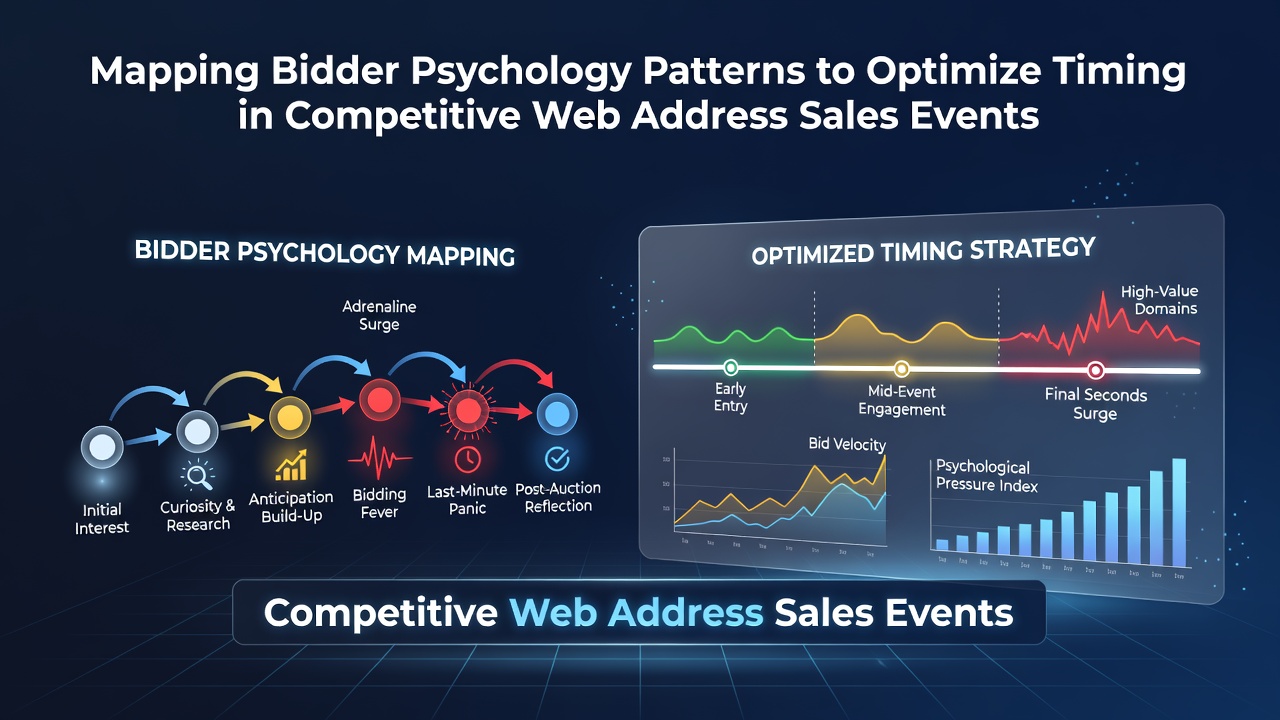
Mapping Bidder Psychology Patterns to Optimize Timing in Competitive Web Address Sales Events
Competitive web address sales events operate through structured auction formats where multiple participants place bids on domain names within defined time windows, and researchers have documented distinct psychological patterns that influence when individuals choose to submit their offers. Data from major platforms shows that bidders often cluster activity during the final hours of an auction, a behavior tied to risk aversion and information gathering rather than random chance. Observers note that these patterns emerge consistently across different sale types, allowing analysts to track entry points and escalation thresholds based on historical bid logs.
Core Psychological Triggers in Domain Bidding
Studies of auction dynamics reveal that anchoring effects play a central role when early bids set perceived value ranges, prompting later participants to adjust their maximum willingness to pay around those initial figures. Loss aversion also surfaces frequently, where individuals escalate commitments to avoid missing a desired name, especially once they have invested time monitoring an event. According to auction theory research from the University of Chicago Booth School of Business, participants who observe rapid price increases in the middle phase tend to delay their responses until clearer signals of competition strength appear.
Another documented pattern involves social proof mechanisms, in which visible bid counts encourage additional entries even when individual valuations remain unchanged. Those who have analyzed transaction records across multiple registries find that auctions with higher early activity draw proportionally more late-stage participants, creating self-reinforcing cycles. Timing optimization therefore requires mapping these entry clusters against remaining duration, because data indicates that bids placed after 70 percent of the auction window has elapsed correlate with different psychological drivers than those submitted in the opening segment.
Data Patterns Observed in Recent Sales Events
Records from 2025 and early 2026 auctions demonstrate that sniping behavior, defined as bids submitted in the final minutes, accounts for roughly 35 to 45 percent of winning offers in high-competition categories. This timing preference aligns with efforts to minimize counter-bidding opportunities, and analysts tracking platform logs have identified consistent spikes between 85 and 95 percent of elapsed time. In August 2026 several registries reported elevated volumes during evening hours in North American time zones, suggesting circadian influences on decision speed that operators can factor into predictive models.
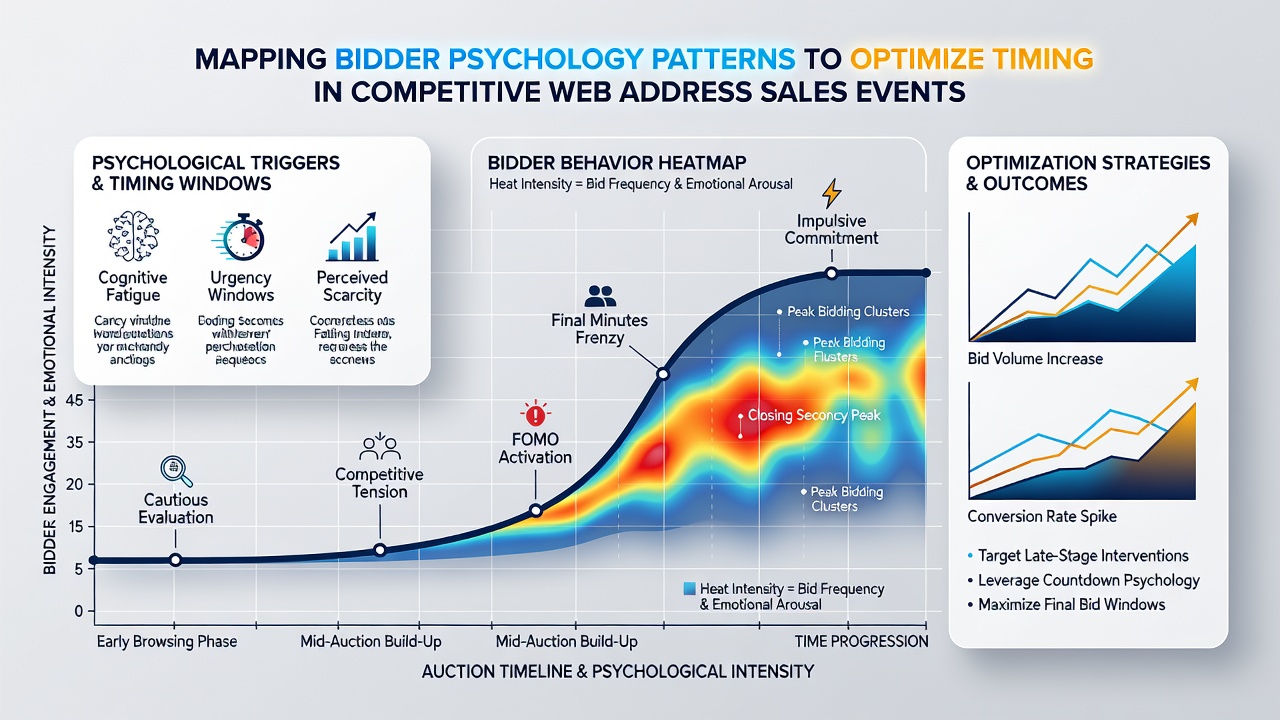
Heat maps generated from aggregated bid histories further illustrate how certain psychological segments favor mid-auction aggression to test competitor resolve, whereas others adopt wait-and-see approaches that concentrate activity near closure. These distributions allow timing algorithms to forecast likely response windows once an initial bid pattern becomes visible, and platforms that publish real-time activity metrics enable participants to adjust strategies accordingly without violating terms of service.
Applying Pattern Mapping to Timing Decisions
Mapping bidder psychology begins with categorizing observed behaviors into segments such as early anchors, mid-phase testers, and late-stage responders, then correlating each segment with historical conversion rates. Auction operators and participants alike use these categories to identify when escalation is most probable, because evidence shows that interventions during identified transition periods produce measurable shifts in final prices. For instance, when early bidding volume exceeds median thresholds, subsequent activity tends to accelerate after the halfway mark, prompting preemptive timing adjustments.
Platforms have incorporated these insights into automated alerts that flag when current patterns deviate from established baselines, giving users data points for recalibrating their own submission schedules. Research compiled by the National Bureau of Economic Research indicates that bidders who synchronize entries with documented psychological transition points achieve higher win rates in controlled simulations, although real-world outcomes depend on additional variables including reserve prices and name category demand.
Integration with Platform Features and Regulatory Context
Many sales platforms now provide timestamped bid histories and activity graphs that facilitate direct pattern recognition, and these tools support objective analysis without requiring subjective interpretation. Regulatory frameworks in various jurisdictions, including guidelines from the Australian Competition and Consumer Commission, emphasize transparent disclosure of auction mechanics so that participants can make informed timing choices based on available information. Similar oversight exists through bodies such as the Federal Trade Commission in the United States, which monitors practices that could distort competitive bidding dynamics.
Those analyzing cross-platform data note that integration of psychological mapping with real-time feeds reduces uncertainty around optimal entry moments, while still operating within the rules established by each registry. Continued refinement of these approaches relies on accumulating larger datasets from events throughout 2026 and beyond, enabling more granular segmentation of bidder cohorts.
Conclusion
Pattern mapping in competitive web address sales rests on documented behavioral regularities that emerge from bid timing distributions, escalation sequences, and response latencies across thousands of completed auctions. By aligning submission strategies with these empirically observed clusters, participants can position offers during windows where psychological drivers favor particular outcomes, and platform analytics continue to supply the raw data needed for ongoing refinement of such models.