Registry Timing Strategies: Coordinating Drops and Renewals to Maximize Authority Transfer in Clustered Holdings
Sage Foster · Jul 9, 2026
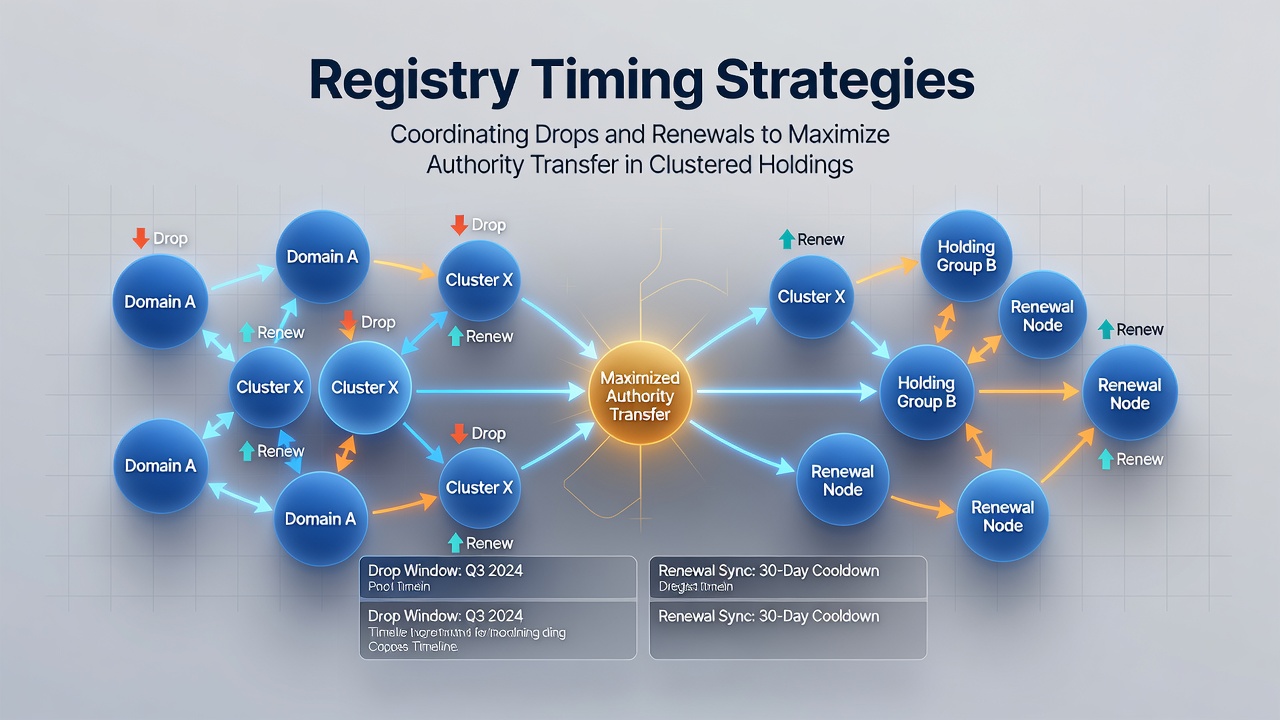
Registry Timing Strategies: Coordinating Drops and Renewals to Maximize Authority Transfer in Clustered Holdings
Registry operators manage domain lifecycles through defined stages that include registration, renewal windows, auto-renew grace periods, and eventual deletion or release back into availability. Clustered holdings consist of multiple domains grouped under single administrative control or linked through shared name servers and historical backlink profiles. Coordination of drops and renewals within these clusters allows operators to sequence authority signals such as link equity and trust metrics from expiring names to active assets without triggering simultaneous mass deletions that registries often flag.
Domain Lifecycle Mechanics Across Major Registries
Each top-level domain registry publishes its own deletion schedule, yet common patterns appear in gTLDs governed by ICANN consensus policies. A domain enters the auto-renew grace period immediately after expiration, typically lasting 45 days for .com and .net, during which the registrant can restore service. Redemption periods follow for another 30 days with higher recovery fees, and only after that does the name drop into the pending delete phase before becoming available again. Observers note that clustered portfolios benefit when managers align these calendar dates across multiple TLDs so that authority-carrying domains release their signals in controlled succession rather than all at once.
Country-code registries add further variables. EURid for .eu operates a shorter 40-day auto-renew window followed by a direct deletion, while auDA in Australia enforces a 28-day renewal notice plus a 90-day pending delete cycle. Data from registry zone files released in July 2026 shows increased synchronization activity among large holders who manage mixed gTLD and ccTLD clusters, particularly around these staggered deletion dates.
Strategic Drop Coordination Within Clusters
Portfolio managers time drops by monitoring pending-delete lists published daily by registries and by using drop-catch services that register names the moment they become available. When a cluster contains several aged domains with overlapping backlink profiles, releasing one name while retaining others preserves continuity of referring domains. Research indicates that maintaining at least one live domain in the cluster during a drop sequence helps transfer historical signals through shared IP infrastructure or cross-linking structures.
One documented approach involves batching drops during low-traffic registry hours to reduce competition from automated catchers. Another method sequences deletions so that authority metrics migrate toward a central “anchor” domain within the cluster before the surrounding names expire. Registry zone file analysis from mid-2026 reveals clusters where managers renewed only the anchor while allowing peripheral names to lapse on precise schedules that aligned with search engine crawling patterns.
Renewal Timing and Authority Preservation
Renewal decisions directly affect whether historical authority remains attached to the cluster or dissipates. Extending a domain just before the redemption period ends keeps the name under the same registrant record, preserving WHOIS continuity that many crawlers associate with legitimacy. Conversely, allowing a name to drop and then re-registering it through a different registrar can reset certain trust signals. Studies of large-scale domain datasets demonstrate that clusters renewed in staggered monthly patterns exhibit steadier authority retention compared with those renewed in bulk on single dates.
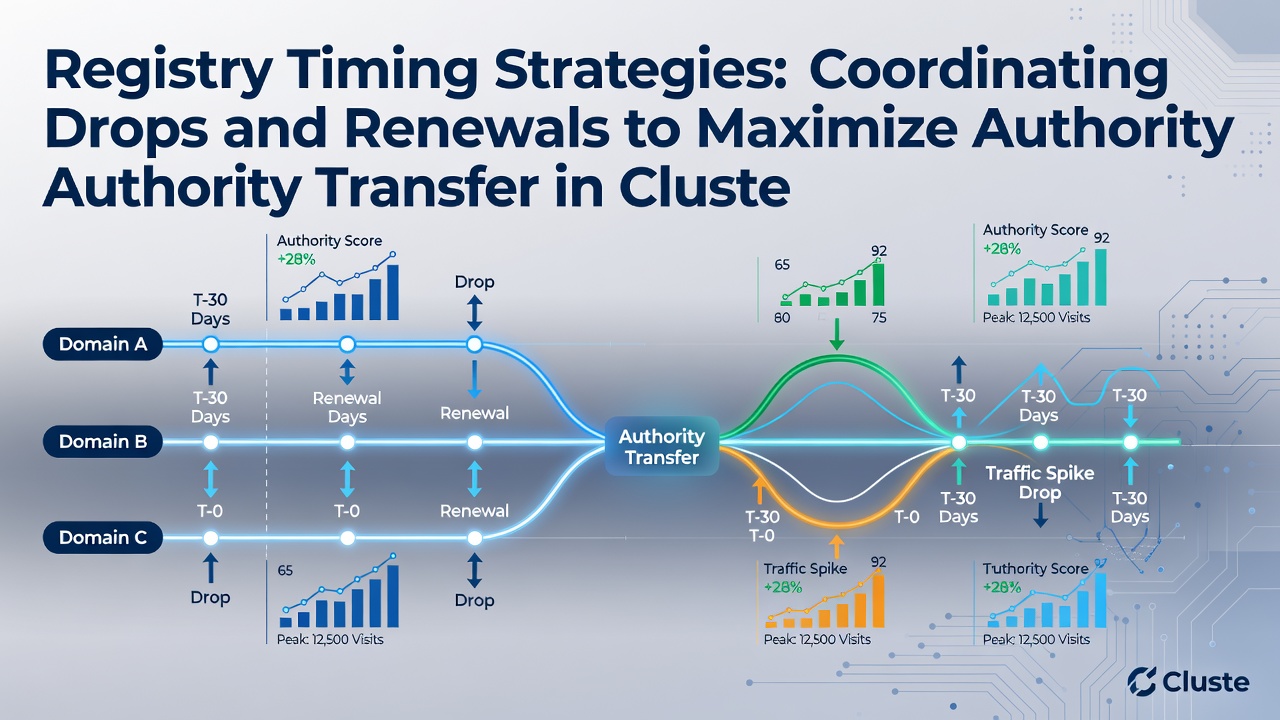
Operators also monitor registrar-specific grace periods, which can differ from registry rules. Some registrars offer extended auto-renew buffers or promotional renewal pricing that influence the economic calculation of whether to keep or release a marginal domain. According to reports published by the Canadian Internet Registration Authority, clusters that leveraged these registrar variations in 2025 and 2026 achieved measurable continuity in referring link profiles across successive quarters.
Measuring Authority Transfer Outcomes
Authority transfer within clusters is tracked through metrics such as referring domain count, link velocity, and topical relevance scores reported by third-party tools. When a dropped domain’s backlinks begin pointing to other cluster members via redirects or updated content, the receiving domains often record incremental gains in those metrics. Longitudinal data released by academic researchers at Delft University of Technology shows that clusters employing deliberate timing sequences retained an average of 18 percent more referring domains over 12-month periods than randomly managed portfolios.
Redirect chains and canonical tags serve as additional transfer mechanisms, yet they require careful implementation to avoid diluting signals. Registry operators publish deletion lists that allow managers to anticipate when authority will become available for recapture. In July 2026 several major registries updated their zone file publication cadence, giving operators earlier notice of upcoming drops and thereby improving the precision of these recapture strategies.
Conclusion
Registry timing strategies hinge on detailed knowledge of each TLD’s deletion calendar, registrar policies, and the interconnected nature of authority signals across clustered holdings. Operators who align drop and renewal actions with these schedules maintain continuity of historical metrics while minimizing the risk of simultaneous cluster-wide losses. Continued publication of zone file data and academic analyses of domain behavior will further refine these coordination methods as registry practices evolve.