Synchronizing Registration Cycles Across Clustered Names to Boost Enduring Search Performance Gains
Jordan Lang · Jun 20, 2026
Synchronizing Registration Cycles Across Clustered Names to Boost Enduring Search Performance Gains
Domain clusters consist of multiple related names registered under coordinated ownership structures, and alignment of their registration cycles has emerged as a key operational tactic for maintaining consistent digital footprints. Search engines track registration data through WHOIS records and renewal patterns, which can influence how authority signals propagate across interconnected properties over extended periods. Observers note that staggered expirations within a cluster often lead to fragmented renewal events, creating windows where individual names drop out of active status and disrupt the overall linkage graph that engines evaluate for relevance.
Mechanics of Registration Alignment
Registration cycles typically span one to ten years depending on registrar policies and TLD requirements, and synchronization involves setting all names in a cluster to renew on matching intervals. This process relies on bulk management tools provided by registrars, which allow administrators to adjust expiration dates through prorated renewals or transfers that reset timelines without altering underlying ownership records. Data from ICANN compliance reports shows that coordinated renewals reduce the incidence of lapsed names by aligning payment schedules and avoiding the administrative overhead associated with individual monitoring.
Clustered names often share thematic or brand elements, such as variations around a core keyword set, and their synchronized cycles ensure that ownership continuity appears uniform to external crawlers. Research indicates that search algorithms incorporate temporal signals from domain histories, including the duration of uninterrupted registration, when calculating trust metrics; clustered alignment extends these uninterrupted periods across the group simultaneously rather than in sequence.
Impact on Search Performance Metrics
Enduring performance gains appear in metrics like indexation stability and backlink retention when clusters maintain synchronized active status. Studies from academic sources, including analyses conducted at institutions in Australia, reveal that domains with aligned renewal histories demonstrate lower rates of de-indexation events during routine engine updates. The effect compounds because engines treat the cluster as a cohesive unit for certain evaluation purposes, where a single lapse can trigger reevaluation of neighboring names within the same ownership footprint.
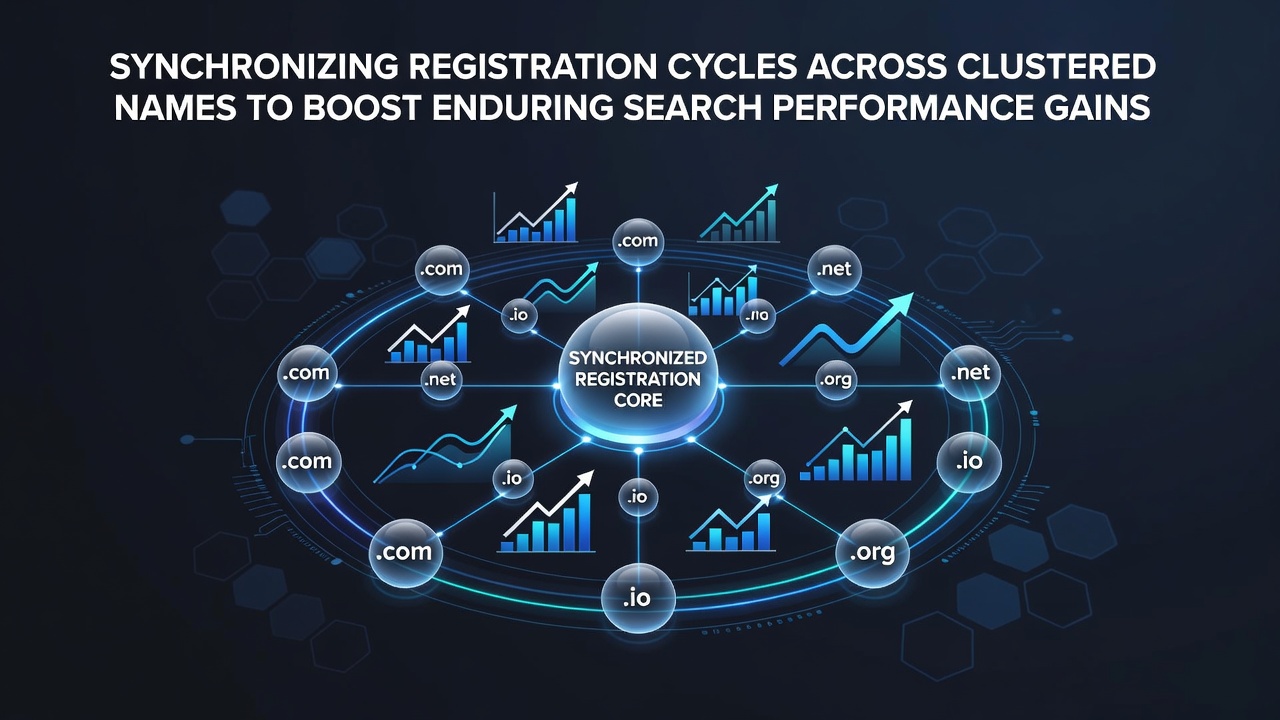
Industry reports compiled by European digital infrastructure bodies highlight that clusters operating under unified cycles experience steadier crawl frequencies, as engines prioritize resources toward domains with predictable availability patterns. This predictability stems from the reduced likelihood of expiration notices interrupting the steady flow of updates that search systems monitor through automated checks. Those managing large portfolios observe that synchronization also streamlines compliance with registrar verification processes, which often occur in batches tied to renewal windows.
Implementation Approaches in 2026
By June 2026, registrars have expanded API capabilities that facilitate precise cycle adjustments across multiple names without requiring individual transfers. These tools integrate with portfolio management platforms to flag upcoming expirations and propose alignment options based on existing registration lengths. Organizations handling clusters report using these features to shift renewal dates by months at a time while preserving the original creation dates that engines reference for age-related signals.
Practical application involves auditing current expiration dates within a cluster, calculating the median renewal point, and executing prorated extensions to converge on that target. Canadian regulatory filings on domain management practices note that such alignments have become standard among entities maintaining extensive name inventories, particularly when clusters span multiple TLDs with differing default cycle lengths. The process avoids creating artificial gaps in registration history that could flag as suspicious during automated reviews.
Long-Term Effects on Portfolio Resilience
Over multi-year horizons, synchronized cycles contribute to resilient performance by minimizing exposure to renewal-related disruptions that might otherwise fragment authority distribution. Evidence from longitudinal tracking of domain groups suggests that clusters with aligned timelines retain higher proportions of accumulated link equity during algorithm shifts, because the entire set presents a continuous operational record to evaluation systems. This continuity supports sustained visibility in results pages where engines reward stable domain histories.
Administrators achieve these outcomes through scheduled reviews conducted at fixed intervals, often tied to annual reporting cycles, ensuring that any new names added to a cluster immediately adopt the established synchronization standard. The approach scales across portfolios of varying sizes, from small thematic sets to expansive collections spanning hundreds of names, as bulk tools handle the necessary date adjustments without proportional increases in manual effort.
Conclusion
Synchronized registration cycles across clustered names provide a structured method for preserving consistent ownership signals that support ongoing search performance. Through the use of registrar tools and periodic audits, clusters maintain uniform renewal patterns that align with how engines process temporal and continuity data. As management platforms evolve, these practices continue to integrate into standard portfolio operations, delivering measurable stability in indexation and authority metrics across extended timeframes.